
Executive Summary


As geopolitical tension, economic uncertainty and strategic competition transform global markets, businesses must strengthen adaptability, visibility and resilience to manage disruption, protect growth and remain competitive.
The era of predictable globalisation is giving way to a more fragmented world where politics, security priorities and economic policy increasingly influence access to supply chains, technology, data, capital and critical infrastructure. In this environment, the organisations that can adapt fastest will be best positioned to succeed.
When critical infrastructure becomes a critical weakness
At the same time, hidden dependencies are creating new vulnerabilities and concentration risks. Many organisations rely on critical dependencies such as cloud infrastructure, payment networks, satellites, undersea cables and GPS. Disruption to any one of these critical services can trigger cascading operational, financial and supply chain disruption.
Conflict, tariffs, trade tensions and competition for strategic resources are rewriting the rules of global business. In our latest Risk & Resilience survey, 90% of executives say geopolitical tension and economic uncertainty are restricting their business growth, while more than four in five say political change is affecting profitable trade.
As assumptions about markets and stability are tested, resilience, agility and adaptability are becoming critical competitive advantages.
The impact of geopolitics on business optimism
The percentage of global executives that agreed with these statements in Beazley’s Risk & Resilience surveys in January 2025 and 2026, and July 2026.
-
Access: The new source of competitive advantage
Tariffs, sanctions and restrictions on market access are reshaping procurement, investment and growth strategies with little warning. At the same time, access to critical supplies, energy, capital and digital infrastructure is becoming a source of strategic advantage.
As cloud services and data flows become increasingly tied to national security, businesses must understand and reduce critical dependencies, strengthen resilience and maintain operational flexibility.
From hyper efficiency to structural survival
Business models built around maximum efficiency, lean inventories, just-in-time supply chains and tightly integrated technology ecosystems are being tested in a fragmented, less predictable world.
-
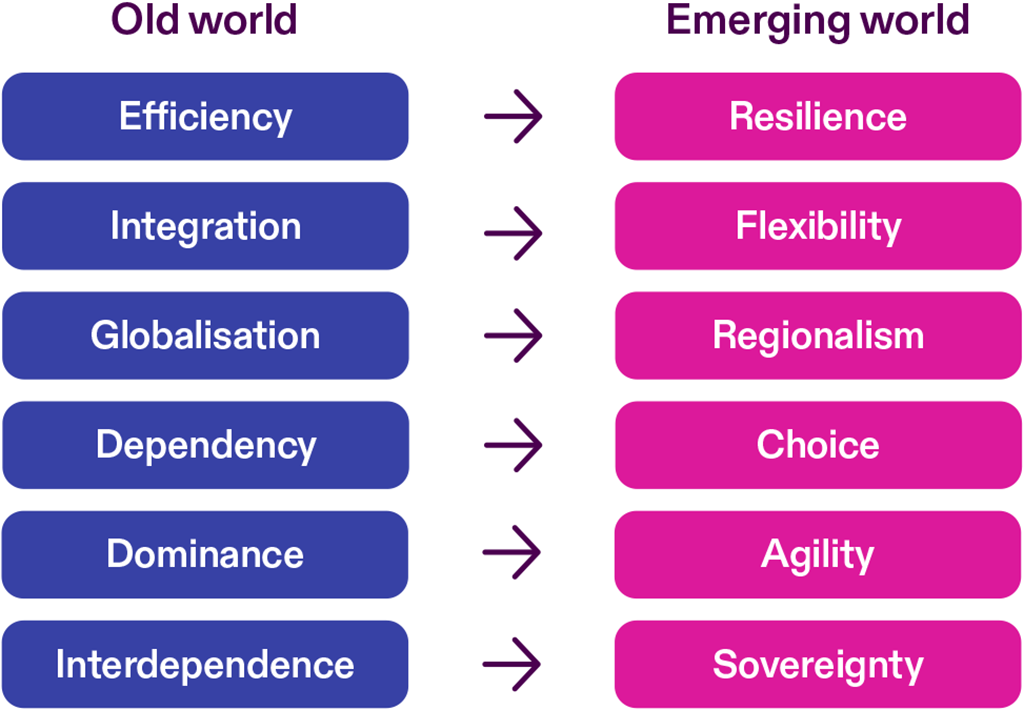
Resilience now matters as much as efficiency
In today's interconnected economy, resilience is as important as efficiency. Priorities must extend beyond cost reduction to ensuring continuity during disruption.
Building resilience requires greater agility, fewer single points of failure, stronger visibility of critical dependencies and the financial strength to absorb shocks and respond effectively to change.
Connected risks: One spark, multiple fires
Disruption rarely arrives alone in today’s interconnected risk landscape. Cyber, physical, regulatory and financial risk increasingly occur simultaneously, amplifying losses and making traditional forecasting less reliable.
Adaptability beats dominance
Success is no longer determined solely by scale, market share or brand strength. Leading organisations embed horizon scanning, business resilience, financial resilience and specialist risk expertise into decision-making to prepare for changing conditions and converging risks.
Playing the long game
Specialty insurance helps organisations absorb shocks, recover faster and invest with confidence as they redesign supply chains, adapt technology ecosystems and enter new markets.
In a period of persistent disruption, trusted insurance partners and specialty insurance solutions provide the financial foundation businesses need to anticipate, withstand and recover from geopolitical, economic and emerging risks.
The challenge
Geopolitical, economic and technological change will continue to redefine the business environment for the foreseeable future. The organisations that thrive will not be those that predict every disruption, but those that can adapt when conditions change.
Long-term success depends on staying in the game while the pieces are moving, maintaining the resilience, visibility and strategic flexibility needed to navigate uncertainty and seize new opportunities.

Paul Bantick, Chief Underwriting Officer, Beazley