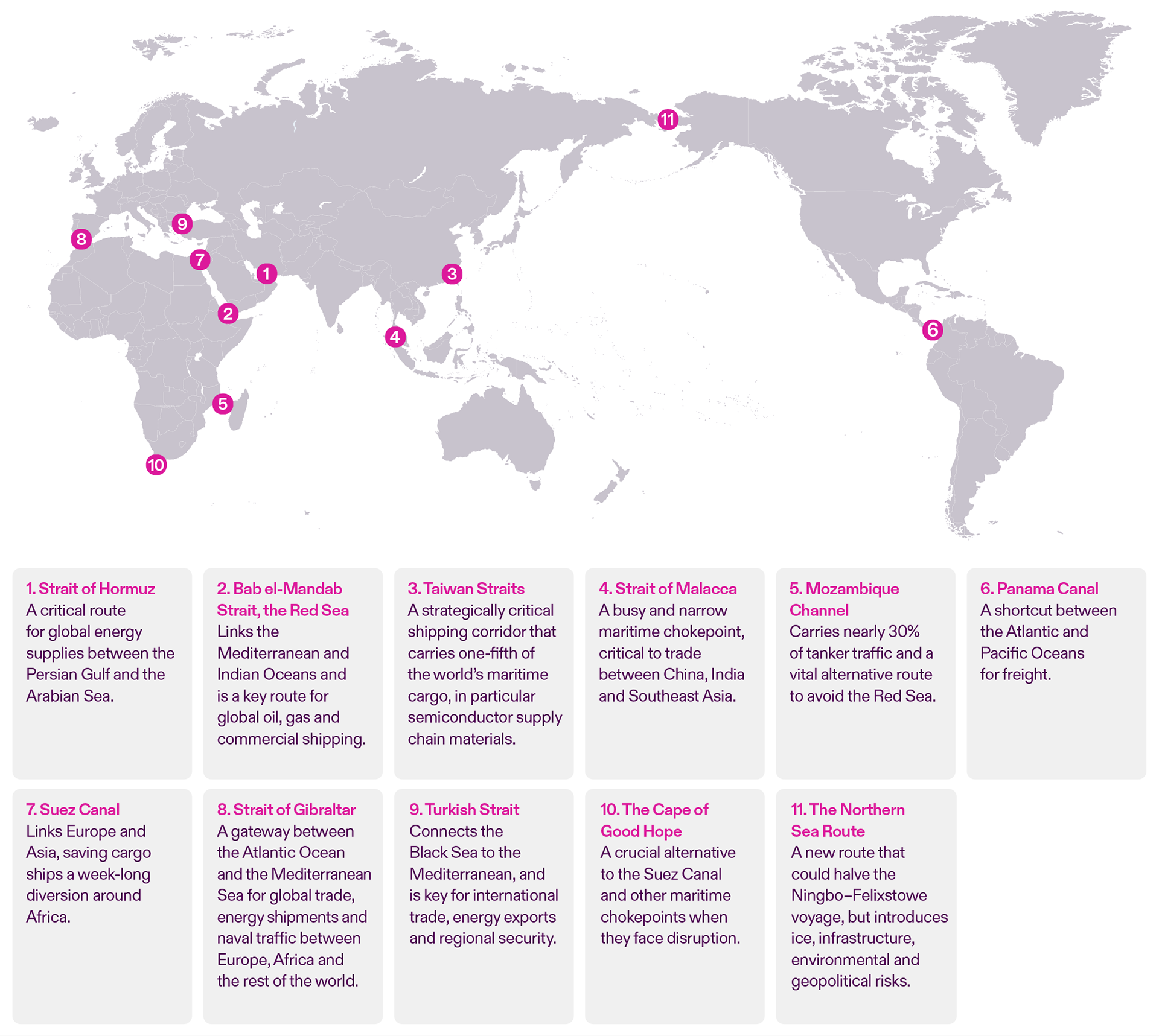
A supply chain chokepoint with global consequences
The issues with the Strait of Hormuz amid escalating US-Iran tensions have exposed the world's reliance on the maritime trade corridor. The disruption to critical commodities quickly revealed hidden dependencies across global industries17:
-
Technology, healthcare and defence supply chains
Iran’s March 2026 naval blockade and attacks on helium plants, and the disruption to production removed approximately one-third of global helium supply from Qatar in a single day18, affecting industries ranging from semiconductor and AI chip manufacturing19 to healthcare20.Food and agricultural systems
Reduced availability of Middle Eastern exports of urea and ammonia21 saw fertiliser costs increase, putting strain on agricultural output and potentially inflating food prices22.Energy and industrial production
Naphtha and LNG shortages raised costs across energy-intensive industries, disrupting downstream plastics, chemicals and electronics23. -
Advanced manufacturing and clean energy supply chains
Sulphur and aluminium shortages24 exposed dependencies in industrial chemicals25, aerospace26 and automotive production27, raising costs across multiple sectors.Consumer goods and chemical manufacturing
Methanol and monoethylene glycol (MEG) supply restrictions disrupted global chemical manufacturing28 and retail29 supply chains worldwide.Both technology products and services rely on the movement of physical resources. When critical commodities are disrupted, even the most advanced industries can experience operational constraints. Executives must maintain visibility of material dependencies, as geopolitical shocks can halt production regardless of demand.
"Most organisations don't have complete visibility of their supply chains. It often takes a major crisis to reveal how deeply connected suppliers, partners and dependencies really are."

Emily Benson, Head of Strategy, Minerva Technology Futures
Trading efficiency for flexibility
-
The traditional supply chain formula of cost, speed and consistency is giving way to a greater focus on optionality, with businesses seeking to diversify:
- Suppliers
- Manufacturing locations
- Markets
- Trade routes
The goal must be to ensure that the failure of one route, region or supplier does not halt an entire operation or economy.
-
“Supply chain disruption can’t be treated as a standalone operational issue. With sanctions and tariffs being used as political leverage, the requirements can change with minimal warning. For manufacturers reliant on global supply, a single policy decision can impact sourcing, compliance, costs and operational continuity.”

Gerard Bloom, Co-Lead Specialty Risks, Beazley
Diversification does not eliminate risk
Reliance on the same infrastructure creates concentration risk, even as supply chains are becoming more geographically diverse.
- Energy markets: Alternative export routes offer flexibility, but few can replace maritime chokepoints that are critical to oil and gas transportation.
- Critical minerals: Mining, refining and manufacturing span different regions. Finding alternative supply offers limited protection if processing remains dependent on one location or country.
- Manufacturing: Manufacturers favour geographical diversification over total market withdrawal, as seen in the rise of the 'China+1' strategy30, but dependencies will persist; China remains a bottleneck across key production stages and new options bring new challenges.
A disruption affecting any of these dependencies can impact thousands of organisations, generating losses across sectors, regions and insurance classes.
“Decoupling doesn't necessarily reduce dependency risk; it changes where that risk sits. Businesses must look beyond immediate suppliers and ask what access they would lose if disruption occurred, how long operations could continue and whether they have a viable, tested alternative.”

Dr Ahana Datta Fasel, Geopolitical, technology and systemic risk adviser
Resilience comes at a cost
-
Organisations may lengthen supply chains, increase inventory holdings, use multiple suppliers or reroute shipments to reduce reliance on a single region. While these measures improve continuity, they create operational complexity, additional cost and change an organisation’s risk profile in unexpected ways.
-
“For marine insurers, a change in route can be as important as a change in the cargo itself. Longer voyages, higher values in transit and new accumulation points can materially alter the exposure. Cover therefore needs to be reviewed as supply chains change, rather than only at renewal.”

Sundeep Khera, Head of Marine, Beazley
Employee concern is increasing across all regions
The impact of disruption does not stop at supply chains and critical infrastructure. As organisations adapt to this shifting world, sustained operational pressure, skills shortages and complex decision-making environments can increase the likelihood of human error, liability exposures and workforce-related claims.

From crisis to control: building supply chain resilience
Disruption has become a persistent feature of today's operating environment, and businesses are learning to adapt at pace. This is reflected in the 77% of surveyed executives planning supplier and supply chain changes over the next 12 months. As operating models evolve across suppliers, transport routes and inventory strategies, businesses should regularly reassess their changing risk profiles and exposures.
While insurance cannot absorb every direct commercial impact, it can help organisations manage exposures arising from cargo losses, business interruption, trade credit and political risks.
Organisations that understand their changing dependencies, test alternative operating models and align insurance arrangements with evolving exposures will be better positioned to withstand disruption and adapt when volatility tests their resilience.
Global maritime chokepoints